Kun Lbokator – The Khmer ancient martial art
Recognized by UNESCO as a vital piece of world heritage, Kun Lbokator is a sophisticated, millennium-old Khmer martial art that blends animal-mimicking techniques with a profound spiritual history to define Cambodia’s ancient warrior spirit.
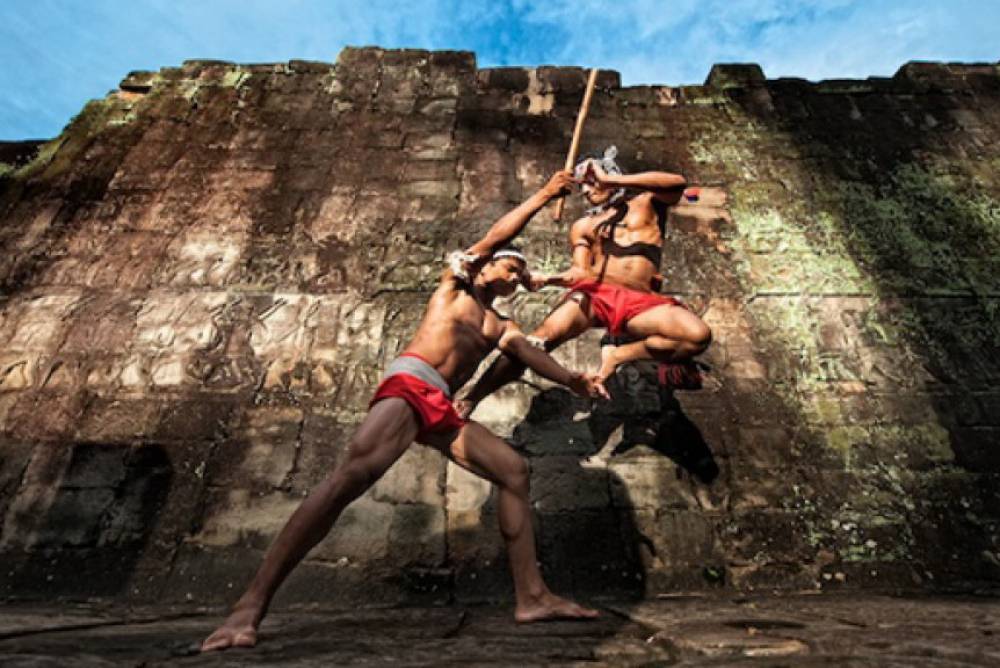
Author: IntoCambodia.org (no individual author listed)
Source: IntoCambodia.org
Kun Lbokator, known formally as Lbokator (គុនល្បុក្កតោ), is a Khmer martial art form that involves close hand-to-hand combat, ground techniques, and weapons. Lbokator is one of the earliest Khmer martial art dating back to the pre-Angkorian period, and is said to be the close-quarter combat system used by the armies during the Angkor era. Practitioners are trained to strike with knees, elbows, hands, feet, and even the head, and short sticks are commonly used as a weapon.
Kun Lbokator is a martial art dating back to the first century. It aims to develop the mental and physical strength and discipline of its practitioners through self-defence techniques and a philosophy of non-violence. The training includes not only physical techniques and skills but also mental discipline on how to respect nature and behave with decorum in society. It is characterised not only as a martial arts form, but also embodies certain cultural aspects.
For instance, the rituals and social practices observed in Kun Lbokator require that the practitioner possesses knowledge about nature and the universe. Practitioners are required to train and master striking and defence techniques using only bare arms and legs, and only once a student demonstrates proficiency are weapons introduced. Another essential aspect of Kun Lbokator is that it is practiced with an ensemble of elements including dance, music, natural medicine, sacred objects and/or amulets, tattoos, and weapons. Masters play a crucial role in the performing aspect of Kun Lbokator because they serve as mediators between the apprentices, guardian spirits, and the surrounding nature, asking for protection and safety in training. Practitioners, in return, pledge to show respect to others and to become good citizens.
Practitioners of Kun Lbokator consist of masters, assistant teachers and apprentices who can join local Kun Lbokator training schools or clubs in their area. They are responsible for maintaining the practice and honoring the philosophy behind Kun Lbokator.
1. The Masters are responsible for training apprentices by transmitting its values and tenets to them. Some of them run and manage their own Kun Lbokator training schools to share their knowledge and skills of Kun Lbokator with younger generations. While serving as masters, they work in different occupations as rice farmers, local business owners, retired civil servants, musicians, actors, film directors, former professional boxers or military veterans. The masters, who have fully apprehended the history, knowledge, techniques, and skills of Kun Lbokator through many years of practice (at least 5 years), transmit their knowledge and skills of Kun Lbokator to new generations through training with encouragement and support from host communities.
2. Assistant Teachers are talented apprentices, selected among themselves, who can assist their masters in training new apprentices.
3. Apprentices are local school students or villagers within the vicinities of Kun Lbokator training schools who want to study and learn Kun Lbokator. Despite the fact that some customary roles from which women play less active in certain ritual practices and festive events, Kun Lbokator provides an equal opportunity for female practitioners to be trained.
4. Other advocates are individuals who possess some Kun Lbokator skills, but are not formal representatives, yet they actively advocate for widespread recognition of this traditional martial arts form.
The term “Kun Lbokator” translates as “pounding a lion” from the words bok, meaning to pound, and tor, meaning lion. A common misunderstanding is that Lbokator refers to all Khmer martial arts when it really only represents one particular style. It uses a variety of elbow and knee strikes, shin kicks, submissions and ground fighting. During fighting, Lbokator exponents still wear uniforms of ancient Khmer armies: a scarf (Krama) folded around their waist and blue and red silk cords called Sangvar day tied around the combatants’ head and biceps. In the past, these cords were believed to be enchanted to increase strength, although now they are mainly ceremonial.
All the great buildings of Angkor are inscribed in Sanskrit and devoted to Hindu gods, notably Vishnu and Shiva. Nowadays, Kun Lbokator practitioners begin each training session by praying with respect to Brahma. Religious life at Angkor was dominated by Brahmins, who in India also practised sword fighting and empty-hand techniques.
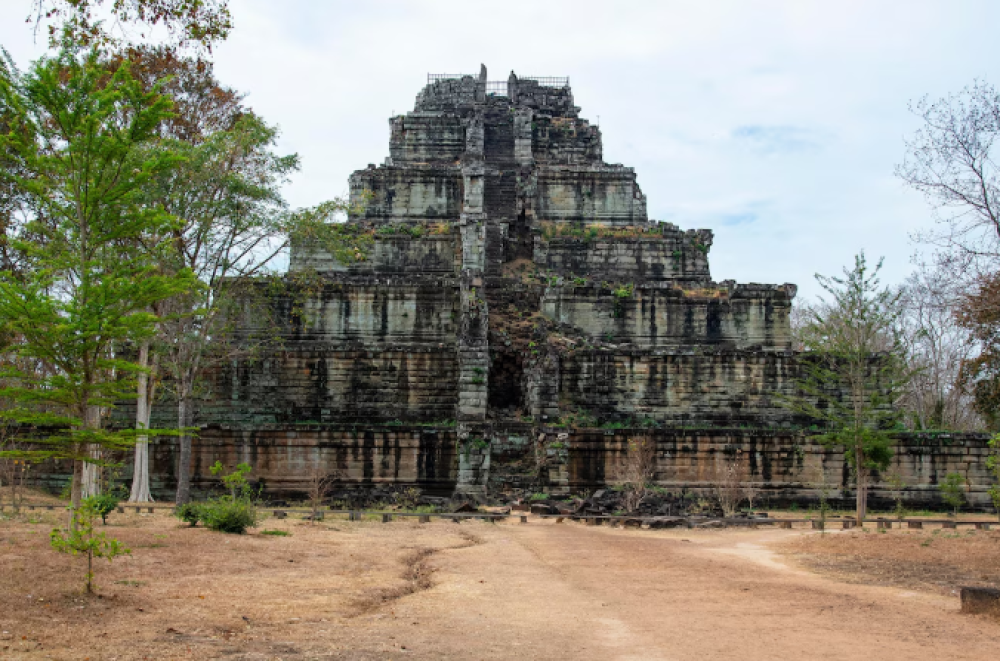
Kun Lbokator contains elements of customs, knowledge and history that have been inherited and passed down through generations since the Angkor period. There is evidence depicting various Kun Lbokator techniques in bas-relief at the base of the entrance pillars to the Bayon temple, including men grappling and fighters using their elbows, which are standard techniques in modern forms like Kun Khmer and Pradal Serei. Another relief shows a man facing off against a cobra and a fourth shows a man fighting a large animal. Cambodia’s long martial heritage may have been a factor in enabling successive Angkor kings to dominate Southeast Asia for over 600 years beginning ~AD 800.
During the dark time of the Pol Pot regime (1975-1979), those who practised traditional arts were either systematically exterminated by the Khmer Rouge, fled as refugees, or stopped teaching and hid their knowledge. After the Khmer Rouge regime ended, the Vietnamese occupation of Cambodia outlawed native martial arts.
Presently, there are about 7,000 individual practitioners of Kun Lbokator, and twelve dedicated grand masters are committed to safeguarding and transmitting the tradition. These include Masters Ith Pen, Sen Sam Art, San Kim Sean, Ros Serei, Am Yom, Suong Neng, Ponh Keun, Voeng Sophal, Ke Sam On, Kim Chiev, Chet Ay and Kao Kob. Kun Lbokator community schools exist in thirteen Cambodian provinces — Kampot, Takéo, Kampong Chhnang, Kampong Thom, Siem Reap, Pailin, Pursat, Koh Kong, Banteay Meanchey, Svay Rieng, Prei Veng, Tboung Khmum, and Kandal — where grand masters teach with support from local communities. The martial art is also practised outside Cambodia in places such as the United States, Europe and Australia by Cambodian diaspora communities who support its preservation.
There are similar styles and practices to Kun Lbokator in neighbouring countries that were once part of the Khmer Empire, including Muay Thai in Thailand and Muay Laos in Laos, which developed in conformity with their own environments, nature and history.
To further promote and safeguard Kun Lbokator, the Cambodia Kun Lbokator Federation was formed under the auspices of the National Olympic Committee of Cambodia, with support from the Ministry of Education, Youth and Sports. This organisation enables masters and apprentices from across the country to continue practising Kun Lbokator. For example, the first national Lbokator competition was held in Phnom Penh at the Olympic Stadium from September 26–29, 2006 with masters leading teams from nine provinces. In 2017, Bokator was featured in the successful Cambodian martial arts film Jailbreak.
The style and knowledge of Kun Lbokator vary slightly in each region of the country, including physical techniques, tools, terminology, and favoured skills. Kun Lbokator represents one form of creativity in martial arts and is also incorporated into other performing arts such as Chhay Yam musical dance and Lkhon Bassac, a form of Khmer theatrical performance. The meanings and symbolism found in Kun Lbokator practice are also suited for creative arts including theatre, literature, poetry, storytelling, painting, photography and murals. Its inscription (while recognising shared aspects of martial arts) highlights its specificities and the diversity of practices and creativity beyond regions and lineages.
Presently, Kun Lbokator is still actively performed as part of ritual offerings to local protective deities (Neak Ta) as well as in other festive events, and remains widely practised among Cambodians regardless of age, gender or educational background.
As of 29 November 2022, Kun Lbokator, Cambodia’s traditional martial art, was inscribed on the UNESCO Representative List of the Intangible Cultural Heritage of Humanity by the Intergovernmental Committee for the Safeguarding of the Intangible Cultural Heritage, during its seventeenth session hosted by the Kingdom of Morocco in Rabat. This marked one of Cambodia’s six elements inscribed on UNESCO’s list, following Sbek Thom (2008), the Royal Ballet of Cambodia (2008), tugging rituals and games (2015), Chapei Dang Veng (2016) and Lkhon Khol Wat Svay Andet (2018).